 How-to
How to Check Car Battery Health Before It Leaves You Stranded
Last Updated: November 17, 2026
Quick Summary
Check car battery health at home in about five minutes with a multimeter by measuring resting voltage, then cranking voltage. A healthy, fully charged battery rests near 12.6 volts and stays above 9.6 volts while cranking. Below 12.0 volts at rest points to a weak or failing battery.
- Let the battery rest at least an hour before testing resting voltage.
- Set the multimeter to DC voltage on the 20V range.
- A reading between 13.5 and 14.5 volts with the engine running means the alternator is charging.
- White or blue-green crust on terminals means corrosion is blocking current.
- Many auto parts stores test batteries at no charge.
Table of Contents
- How to Check Car Battery Health With a Multimeter
- How to Check Car Battery Health Without a Multimeter
- Where to Test a Car Battery for Free and What the Health Check Percentage Means
- Frequently Asked Questions
How to Check Car Battery Health With a Multimeter
Checking car battery health at home takes about five minutes with a multimeter. A car battery health test measures resting voltage, then cranking voltage, to show whether the battery holds a charge or is fading.
- Turn the engine off and let the battery rest for at least an hour.
- Set the multimeter to DC voltage, 20V range.
- Touch the red probe to the positive terminal and the black probe to the negative terminal.
- Read the display. A healthy, fully charged battery rests near 12.6 volts.
- Start the engine and watch the reading. It should stay above 9.6 volts while cranking.
- With the engine running, check again. A reading between 13.5 and 14.5 volts means the alternator is charging.
A resting reading of 12.4 volts suggests a partial charge. Below 12.0 volts points to a weak or failing battery. Clean any terminal corrosion with a wire brush before you trust the numbers.
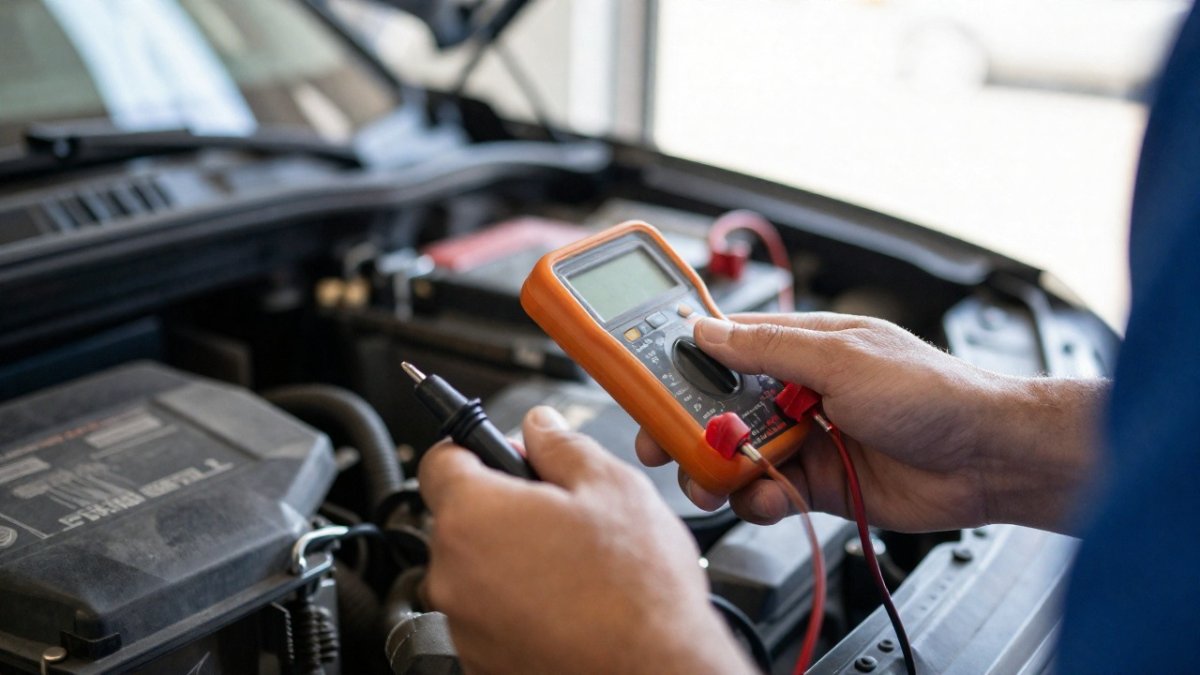
Here is what the multimeter readings mean at each stage of the test.
| Reading | What it means |
|---|---|
| Near 12.6 volts at rest | Healthy, fully charged battery |
| 12.4 volts at rest | Partial charge |
| Below 12.0 volts at rest | Weak or failing battery |
| Above 9.6 volts while cranking | Cranking voltage is acceptable |
| 13.5 to 14.5 volts with engine running | Alternator is charging |
Multimeter voltage readings at each stage of battery testing
How to Check Car Battery Health Without a Multimeter
No multimeter? You can still check car battery health with your eyes, your ears, and a simple load test. These methods reveal warning signs clearly, though they give no exact voltage.
- Look at the terminals. White or blue-green crust means corrosion is blocking current.
- Check the battery case. A swollen or cracked case signals internal damage.
- Listen to the crank. A slow, labored engine start is a classic weak-battery sign.
- Run the headlight test. Turn on the headlights with the engine off. If they dim noticeably over a few minutes, the battery is losing charge.
- Watch the dashboard. A battery warning light or flickering electronics point to a charging problem.
For a load test without a meter, most auto parts stores use a dedicated tester that applies a real load, which is more reliable than any visual check. If your battery is more than three years old and shows two or more of these signs, have it inspected. Our guide on signs your car needs professional inspection covers the symptoms that mean it is time to hand the keys to a technician.
Where to Test a Car Battery for Free and What the Health Check Percentage Means
Many auto parts stores test batteries at no charge, and the printout usually shows a car battery health check percentage. That number is the battery's state of charge compared with its rated capacity, not a guarantee of remaining life.
A reading near 100% means the battery is holding a full charge. Cold cranking amps, or CCA, matter too. A battery rated at 600 CCA that now tests at 400 CCA has lost a third of its starting power, even if the percentage looks decent.
A free test is a good start, but it is a snapshot. Professional diagnostics can check the charging system and look for parasitic drain. Some modern cars may need a new battery registered with the onboard computer so the alternator charges it correctly. If you want to understand why a proper diagnostic beats a quick readout, read our breakdown of why professional vehicle diagnostics beat guesswork. Drivers near me in St. Augustine can also review our full automotive service lineup to see battery testing and charging system checks.
If your checks point to a failing battery, do not wait for a no-start morning. Our article on signs your car needs immediate maintenance explains which warnings should send you to a shop the same day.
A dead battery rarely announces itself. It fails on the morning of a road trip or in a parking lot at dusk. AutoMedix takes the guesswork out of it with skilled technicians, diagnostics that cover the whole charging system, and service for everything from routine maintenance to major repairs. Get started with AutoMedix and know your battery's real condition before it strands you.
Frequently Asked Questions
How do I check if my car battery is good?
Start with a visual inspection for terminal corrosion, swelling, or a cracked case. Then measure voltage with a multimeter: a fully charged battery should read about 12.6 volts with the engine off. Crank the engine and watch for a drop below roughly 9.6 volts, which points to a weak battery or a failing starter. For a complete picture, have the battery load tested and the charging system checked, since voltage alone does not confirm cranking amps or internal resistance.
Can I get my car battery tested for free?
Many auto parts stores will test a battery at no charge, and some mobile services do the same. A free test usually covers voltage and a basic load check, but it may not include a full charging system inspection or battery registration for newer vehicles. If the free result is borderline, a professional car battery health check with a conductance tester gives you a clearer answer before you buy a replacement.
What does a car battery health check percentage actually tell me?
A health check percentage compares your battery's measured cold cranking amps to its rated capacity. A result near 100 percent means the battery still delivers close to its original power; a reading under about 70 percent usually means it is aging and worth watching. The percentage is a guide, not a guarantee, so pair it with a voltage reading, a visual inspection, and a charging system test before deciding to replace the battery.