 How-to
Avoiding Unnecessary Car Repair Costs: 2026 Guide
Table of Contents
- Why Unnecessary Car Repairs Happen (and How to Spot Them)
- How to Check a Car Repair Estimate Before You Approve
- Questions to Ask a Mechanic Before Approving Repairs
- How to Get a Second Opinion on Car Repairs
- Car Maintenance Schedule by Mileage: What Actually Matters
- Prioritizing Repairs by Safety and Urgency
- Frequently Asked Questions
Last Updated: October 5, 2026
Why Unnecessary Car Repairs Happen (and How to Spot Them)
Avoiding unnecessary car repair costs starts with knowing why they happen. Most shops are honest. But some rely on pressure, vague language, and fear to sell work you don't need.
The Federal Trade Commission's guidance on auto repair basics makes one thing clear: you have the right to a written estimate and the right to say no.
Common Upselling Tactics and Red Flags
Watch for these warning signs:
- "Your fluid is dark, it needs a flush today." Dark fluid alone rarely means failure.
- Work is quoted before anyone inspects the car.
- You're told the car is "unsafe to drive" with no written proof.
- The price jumps after you drop the car off.
- No itemized estimate is offered, only a lump sum.
How to Check a Car Repair Estimate Before You Approve
Checking a car repair estimate means reading every line before you sign. Ask three questions: What is the part? Why is it needed? What happens if I wait?
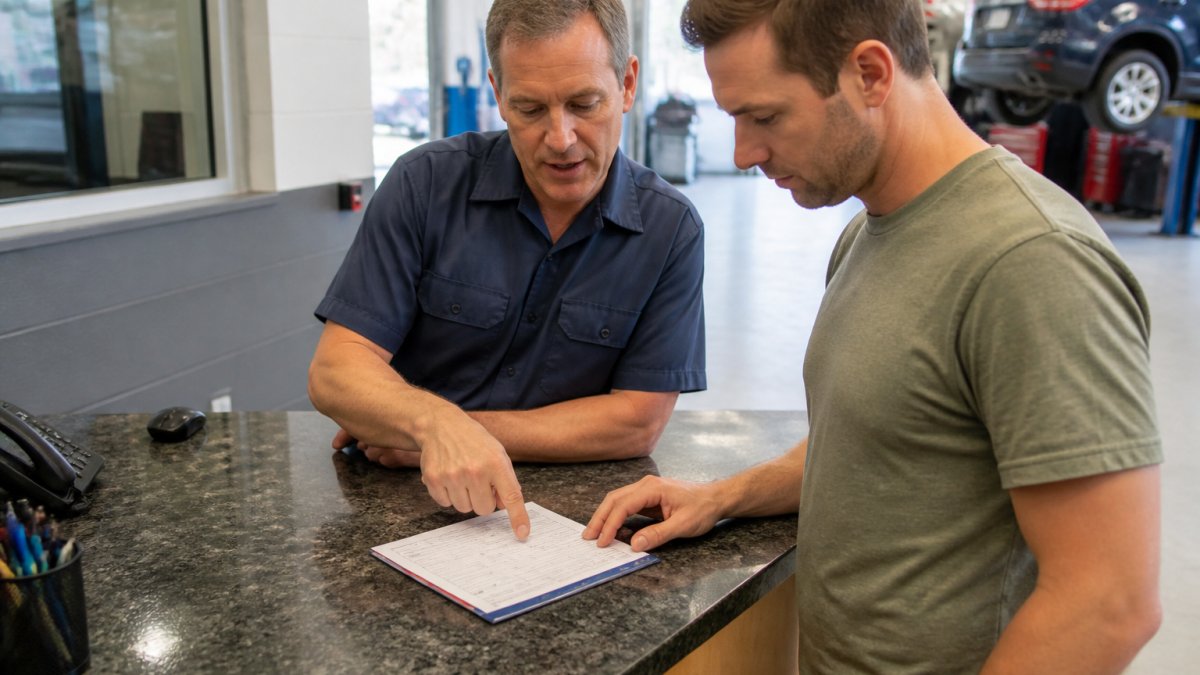
A good estimate answers all three. A bad one uses words like "recommended" with no reason attached.
Separate Diagnosis From Repair
Most estimates mix two different charges, and that's where confusion starts.
- Diagnosis is the time a technician spends finding the fault. It may be a flat fee or an hourly charge, and some shops waive it if you approve the repair.
- Repair is the labor and parts to fix the confirmed fault.
Ask which line is which. If a shop quotes a repair without a diagnosis line, ask how the fault was confirmed. A repair built on a guess is the most expensive kind.
Verify Labor Hours Against Book Time
Flat-rate manuals publish a standard time for most jobs, often called "book time." A shop may bill book time even if the job finishes faster, and that's normal in the industry. What you want to catch is a quote that runs well above the published figure with no explanation.
Ask: "What's the book time for this job, and why is your quote different?" Legitimate answers include rust, seized bolts, or a related part that must come off first. "That's just what we charge" is not an answer.
Compare Parts Options Without Assuming Cheapest Wins
Parts usually fall into three tiers:
| Tier | What It Means | Trade-Off |
|---|---|---|
| OEM | Made by or for the automaker | Highest cost, exact fit, factory warranty terms |
| Aftermarket (OEM-equivalent) | Third-party, built to original specs | Often lower cost, quality varies by brand |
| Used or salvage | Pulled from another vehicle | Lowest cost, unknown remaining life |
For safety-critical parts, brakes, steering, airbags, suspension, OEM or a reputable OEM-equivalent is usually the safer call. For cosmetic or non-critical items, aftermarket can be a reasonable saving. Ask the shop to list the brand and grade on the estimate. If they won't, that's a red flag.
A Step-by-Step Estimate Review
- Request the estimate in writing before any work begins. A verbal number is not an estimate.
- Confirm the diagnosis line and ask what test or symptom led to it.
- Check labor hours against book time and ask about any gap.
- Identify each part's brand and tier, OEM, aftermarket, or used.
- Scan for fees like shop supplies, disposal, and environmental charges. Small fees are normal; vague "misc" lines are not.
- Ask what happens if you wait on each non-safety item.
- Get written authorization terms, what you're approving, and whether the shop must call before adding work.
When to Ask for an Itemized Quote
Ask for an itemized quote any time the total passes what you'd spend without thinking. That's usually anything over a few hundred dollars.
A written, itemized estimate protects you. It also makes it easy to compare shops later. Keep every estimate and invoice, if a dispute arises, the paperwork is your evidence.
Questions to Ask a Mechanic Before Approving Repairs
The right questions to ask a mechanic before approving repairs do two things: they test the diagnosis, and they test the shop's honesty.
Try these:
- What symptom led you to this repair?
- Can you show me the failed part or the test result?
- Is this safety-critical, or can it wait?
- What happens if I delay this for a month?
- Is there a cheaper option that still fixes the problem?
A good tech welcomes these. A bad one gets defensive.
How to Get a Second Opinion on Car Repairs
Getting a second opinion on car repairs is simple: take the written estimate to another shop and ask for their read. Expect to pay a small diagnostic fee. It's worth it.
You're not being disloyal. You're protecting your wallet.
A second shop will often confirm the first diagnosis. Sometimes they'll find the real problem. Either way, you learn something.
Check Coverage Before You Pay Out of Pocket
Before authorizing any repair, run three quick checks. Each one can turn a bill into a no-charge fix.
- Open recalls. Enter your VIN at the NHTSA recall lookup. Recall repairs are performed at no cost to you, even on older vehicles, and many drivers never check.
- Warranty coverage. Review your owner's manual and warranty booklet. Powertrain, emissions, and corrosion coverage often run longer than the basic bumper-to-bumper term. A repair that looks expensive may be covered.
- Service contracts and extended warranties. If you bought one, read what it actually covers and which shops are authorized. Some require pre-authorization before work begins, skip that step and the claim can be denied.
If any of these apply, tell the shop before they start. Once you've paid, reimbursement is much harder to get.
Compare Written Quotes Side by Side
A second opinion is only useful if you can compare it. Ask both shops for written, itemized estimates, then line them up on four points:
- Diagnosis: Do both shops name the same failed part or system?
- Labor hours: Are the quoted hours close, or is one far above book time?
- Parts tier: OEM, aftermarket, or used, and which brand?
- Total out-the-door: Include fees, tax, and any diagnostic charge.
If the two diagnoses differ, ask each shop what test confirmed their conclusion. The one with a concrete answer, a pressure reading, a scan result, a visible failed part, is usually the one to trust.
Know Your Authorization Rights
You have the right to approve work in writing and to be told before any additional work is added. Rules vary by state, but the common pattern is:
- A shop must give you a written estimate before starting.
- The shop must get your approval before exceeding that estimate.
- You're entitled to an itemized invoice showing parts and labor.
Keep every document. If a shop performs work you didn't authorize, your paperwork is the record that matters.
When a Second Opinion Isn't Worth It
Safety-critical items, brakes, steering, tires, airbags, shouldn't wait for a second appointment. If the car is unsafe to drive, get it fixed. Use the second-opinion process for expensive, non-urgent, or vague recommendations, where the savings justify the diagnostic fee.
Car Maintenance Schedule by Mileage: What Actually Matters
A car maintenance schedule by mileage is your best defense against surprise bills. Follow the owner's manual first. It's written for your exact make and model.
Most guides overstate what's needed. Here's what actually matters at each stage.
Key Service Intervals at a Glance
| Mileage | Service | Why It Matters |
|---|---|---|
| Every 5,000-7,500 | Oil change, tire rotation | Protects engine, evens tire wear |
| Every 15,000 | Air filter, cabin filter | Engine performance, air quality |
| Every 30,000 | Brake inspection, fluid check | Safety and stopping power |
| Every 60,000 | Spark plugs, transmission service | Fuel efficiency, reliability |
| Every 90,000+ | Timing belt (if equipped), coolant | Prevents major engine damage |
Check tire pressure monthly. It's free and it saves fuel.
Prioritizing Repairs by Safety and Urgency
Not every repair is equal. Sort each item into three buckets:
- Fix now: brakes, steering, tires, anything that affects control.
- Fix soon: leaks, worn belts, failing battery.
- Can wait: cosmetic issues, minor noises, non-critical sensors.
Safety first, always. But "safety" gets used as a sales word. Ask for the specific risk if a shop claims it.
Check for open recalls at the NHTSA recall lookup. Recalls are free to fix, even on older cars. Many drivers never check.
Frequently Asked Questions
What is the $3,000 rule for car repairs?
The $3,000 rule is a general guideline some financial advisors use: if a repair costs more than the vehicle's value or exceeds roughly $3,000, it may be worth evaluating whether to repair or replace the car. It is not an official industry standard. Instead of relying on a fixed number, compare the repair cost to your car's current market value and consider your budget, safety needs, and how long you plan to keep the vehicle.
How can I tell if a mechanic is recommending unnecessary repairs?
Watch for vague explanations, pressure to decide immediately, and recommendations that do not match your owner's manual or service history. Ask for the diagnostic trouble code, a written itemized estimate, and photos or measurements supporting the recommendation. A trustworthy shop will explain why the work is needed now, what happens if you wait, and whether any items can be deferred safely. If something feels off, get a second opinion before authorizing work.
Should I get a second opinion on a car repair?
Yes, for any repair over a few hundred dollars or when the diagnosis feels unclear. A second opinion from another shop can confirm whether the recommended work is truly necessary and whether the price is fair. Bring your written estimate, any diagnostic codes, and a description of symptoms. Many shops charge a small diagnostic fee, which is often worth it compared to approving unnecessary repairs. Just avoid delaying safety-critical fixes like brakes or steering.
How can regular maintenance help prevent costly car repairs?
Following your owner's manual maintenance schedule, including oil changes, tire rotations, brake inspections, and fluid checks, helps catch small issues before they become expensive failures. Replacing worn wiper blades, air filters, and spark plugs on time also protects engine performance and fuel efficiency. Keeping maintenance records makes it easier to spot what has already been done, so you can avoid paying twice for the same service and hold shops accountable.
Car repair costs add up fast when you approve work without asking questions. At AutoMedix, we built our shop around the opposite approach: written estimates, itemized line items, and honest answers about what can wait. Our technicians handle everything from routine oil changes to major overhauls, and we'll always tell you what's critical versus what isn't. Get started with AutoMedix and take control of your repair decisions.